Related to your region:
GTAP Data Base
The GTAP Africa 2 Data Base includes data for 42 regions (32 African regions plus 10 other aggregated regions) and the 57 sectors of the GTAP 8.1 Data Base. New and updated I-O tables have been contributed with the help of African economists who were awarded scholarships to contribute this data and pursue research on African economic issues. The GTAP Africa 2 Data Base is packaged with the GTAPAgg aggregation software which is freely available for download after placing an order on the GTAP website.
more info
The GTAP Africa 1 Data Base includes data for 39 regions (30 African regions and 9 other aggregated regions) and the 57 sectors of the GTAP 6 Data Base. Cameroon, Cote d'Ivoire, the Democratic Republic of Congo, Ethiopia, Ghana, Kenya and Sudan are the new I-O tables that have been contributed by African economists who were awarded scholarships to contribute this data and pursue research on African economic issues.
more info
Bringing People Together
Advancing Policy Through Collaboration
Valijon Turakulov, Thomas Hertel, Fazliddin Shamsiev
One of the greatest strengths of the annual GTAP Conference is its ability to bring together researchers and policymakers from around the world who share a commitment to evidence-based policy analysis. The 2026 GTAP Conference, held in Kyoto, provided a forum for 250 participants from 39 countries to exchange ideas, build professional networks, and develop new collaborations around pressing global challenges. GTAP's broader mission is rooted in lowering barriers to high-quality analysis and creating a platform for the discussion and dissemination of new ideas, bringing together a global network of more than 34,000 members.
An example of this community-building occurred at this year's conference, where two participants from Uzbekistan, Valijon Turakulov of Inha University Tashkent and Fazliddin Shamsiev of the Ministry of Economics and Finance of Uzbekistan, met for the first time. Although both are engaged in quantitative economic policy research focused on Central Asia, it was the GTAP Conference that created the opportunity for them to connect. Their story illustrates how the GTAP Network helps foster communities of researchers and policymakers from countries that may have relatively small analytical communities, enabling connections that can grow into future collaborations and strengthen policy-relevant research both nationally and internationally.
This connection was especially timely as Uzbekistan advances toward membership in the World Trade Organization. Uzbekistan first applied to join the WTO in 1994, but its accession process gained renewed momentum when active negotiations resumed in 2020. The country is working toward concluding the process in 2026. As the country evaluates market-access commitments, regulatory reforms, and the economy-wide implications of deeper integration into global trade, GTAP-based analysis can provide valuable evidence on potential impacts across industries, households, trade flows, and the broader economy. Such analysis can help researchers and policymakers identify opportunities, anticipate adjustment challenges, and support informed decision-making throughout the accession process and beyond.
Journal of Global Economic Analysis
The Center for Global Trade Analysis is pleased to announce the latest issue of the Journal of Global Economic Analysis has been released. All articles are open access and include supplementary files that allow for replication of results.
The Journal of Global Economic Analysis, Vol 11, No 1 (June 2026), includes the following articles:
Frank van Tongeren
Frank has been deeply involved with GTAP since its inception. Following his participation in the GTAP Short Course, he returned the next year as an instructor. He served as a GTAP Advisory Board Member since 1996, first on behalf of LEI and subsequently on behalf of the OECD. In 1999, he received the Alan A. Powell Award, recognizing outstanding service on the GTAP Advisory Board. In 2001, Frank led a major review of global models of agriculture and the environment and has contributed a very long list of GTAP resources and publications. Between 2006-2024 Frank held positions at the OECD in Paris where he led policy analysis and modelling in the Directorate for Trade and Agriculture, where his team developed the OECD trade model METRO. Frank currently serves as Vice Chair of the GTAP Scientific Council. His career-long contributions to the community make him a most worthy recipient of induction into the GTAP Hall of Fame.
Niven Winchester
Niven has been active in the GTAP Network since 2005. He works at the interface of climate policy, energy systems and the economy and had a distinguished career with the MIT Joint Program on the Science and Policy of Global Change before returning to New Zealand, where he currently serves as a Senior Fellow with Motu Economic and Public Policy Research. Niven has been honored three separate times as a GTAP Research Fellow, each with a term of three years, recognizing the excellence of his research as well as his data base contributions. Within our community, Niven is most widely known for starting the Journal of Global Economic Analysis, which he co-edits with Tom Hertel. Niven’s tireless work with the JGEA has ensured that this journal is open-access and free to all, including those wishing to make a submission. To accomplish this, he navigated the Open Journal System, which allows us to operate independently of commercial publishing houses. It’s fair to say that without Niven, there would be no JGEA!
The JRC has made significant contributions to the GTAP Data Base by providing high-quality input-output tables for European Union Member States, strengthening the global relevance of GTAP for researchers and policymakers worldwide. Beyond data contributions, the JRC actively uses the GTAP Data Base and model to conduct research on agricultural, climate, and energy policies. The JRC is also a co-host of the Pan-African Network for Economic Analysis of Policies, an initiative that fosters collaboration between researchers and policymakers in and for Africa. The JRC's longstanding partnership, technical innovation, and commitment to collaborative data development exemplify the spirit of service and international cooperation that the Alan A. Powell Award was created to honor.
Thank you, JRC, for your many important contributions to GTAP!
Read More
Janine Dixon
In recognition of her outstanding leadership and internationally significant contributions to CGE modeling, labor market forecasting, and policy analysis. Through her leadership at CoPS, pioneering work on CGE theory and microsimulation methods, and influential public policy engagement in Australia and abroad, she has advanced both the practical application and global impact of economic modeling research.
Ken Itakura
For his influential contributions to international trade policy analysis and the advancement of CGE modeling, particularly through his work on the static and dynamic GTAP Models. His leadership in developing non-tariff measures databases and his widely recognized analyses of major Asia-Pacific trade agreements, including CPTPP, RCEP, and ASEAN integration, have significantly strengthened the field of policy-oriented trade research.
Yaghoob Jafari
For his contributions to CGE modeling, international trade, and agri-food systems research. As an active member of the GTAP Network with a strong record of peer-reviewed publications and conference contributions, his work has advanced applied economic modeling and policy analysis across multiple domains.
Maria Latorre
In recognition of her long-standing and highly impactful contributions to applied CGE modeling and international trade policy analysis, particularly through her work on foreign direct investment, dynamic modeling, and major policy issues such as Brexit, EU trade agreements, and the Inflation Reduction Act. Her sustained engagement with the GTAP Network and dedication to training and mentoring new modelers have significantly strengthened the bridge between CGE research and real-world policy application.
GTAPinR Course
"Running the GTAP Model using R packages HARr and tabloToR"
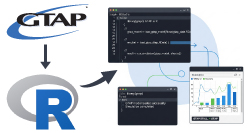
The GTAPinR Course is a self-paced, fully online course aimed at empowering GTAP users with practical tools in R statistical software to enhance simulation analysis for policy making through improved processing of economic model outputs.
2026 GTAP Modeling Trade Policy Course
"Applied Analysis on Trade Policy Instruments"
October 12 – November 29, 2026
|
|
|
Dates/Deadlines (USA Eastern Time Zone)
|
|
Applications
|
April 20 - July 26
|
|
Enrollment
|
Late Aug
|
|
|
The GTAP Modeling Trade Policy (MTP) Course gives professionals and students hands-on training in trade policy analysis using the GTAP computable general equilibrium model (v7). Participants build practical skills in designing policy experiments, applying tariff and non-tariff measures, and interpreting results — grounded in core economic theory and the RunGTAP software environment. The course culminates in team projects assessing real-world trade policy scenarios, including PTA liberalization and tariff hikes, to evaluate their economy-wide and sectoral implications.
|
2027 Short Course in Dynamic Global Trade Analysis
"Applied General Equilibrium Analysis using a Dynamic Multi-Region Model"
January 18 - March 12, 2027 | Purdue University
|

Purdue University
West Lafayette, IN, USA
|
|
Dates/Deadlines (USA Eastern Time Zone)
|
|
Applications
|
April 13 – August 30, 2026
|
|
Enrollment
|
Late September 2026
|
|
Phase 1
|
January 18 – February 28, 2027
|
|
Phase 2
|
March 8-12, 2027
|
|
The objective of this course is to introduce participants to dynamic economic analysis in an applied general equilibrium setting. This course is designed to provide participants with ample hands-on training with software that has been tailored for undertaking analysis using a dynamic recursive model. Participants will interact with economists working on global trade and environmental issues using a dynamic framework. The end goal of the course is for participants to leave with the capability of conducting and analyzing their own dynamic simulations.
|
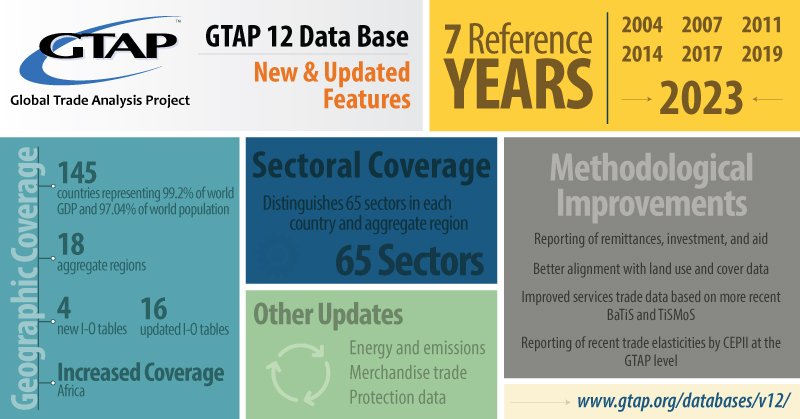
GTAP 12 Data Base Released!
Don't forget to subscribe to our social media and the GTAP-L mailing list
Our email-based mailing list that many members of the GTAP Network are subscribed to. Regular mailings concerning new features of the GTAP Model and/or Data Base, as well as new projects, course offerings and job opportunities. Contributors often use the list to solicit help or ask advice about the modeling framework.
Organizations interested in posting an announcement below and on the GTAP-L Mailing List should email complete details, including contact information and closing dates, to contactgtap@purdue.edu.
|
Job/Professional Opportunities
|
Deadline
|
| There are no job/professional opportunities currently available. |
GTAP Network members in need of technical support are encouraged to use the following avenues to request assistance. General, non-technical inquiries may be addressed to
contactgtap@purdue.edu.
- GTAP FAQs
The Center for Global Trade Analysis maintains a searchable repository of frequently asked questions on many different aspects of GTAP.
- GTAP Support Email
gtapsupport@purdue.edu is an account monitored by the Center for Global Trade Analysis' data team. Network members can email to reach a GTAP staff member for technical support on any GTAP product.
- GTAP-L Mailing List
GTAP-L is an email-based list to which many members of the GTAP Network subscribe in order to receive updates on the GTAP Data Base, model, events, jobs and technical assistance. For further information, to subscribe or to access a searchable archive of GTAP-L messages, please visit the GTAP-L Mailing List homepage